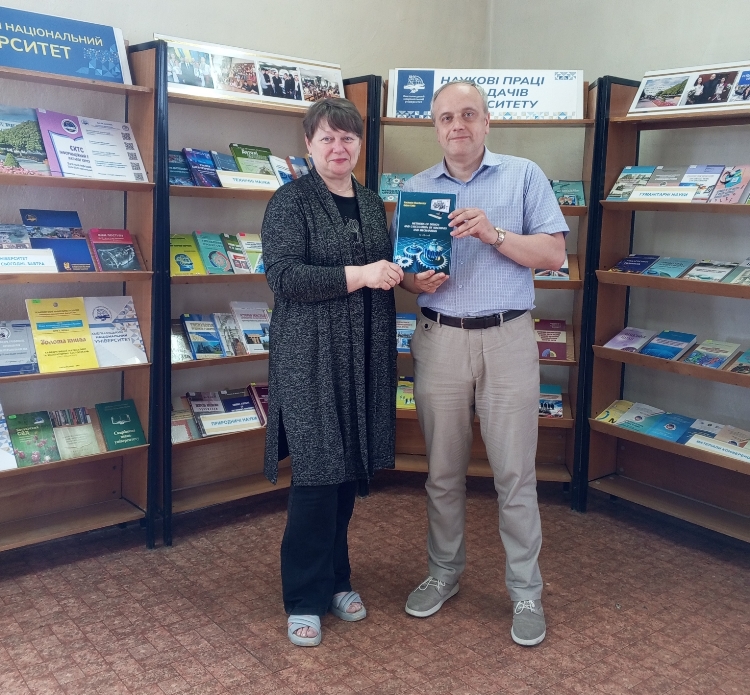
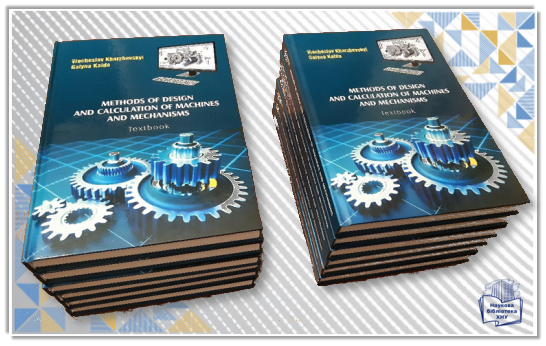
Новий підручник викладачів університету, виданий в університеті «Жешувська політехніка» (Польща), передано до наукової бібліотеки.
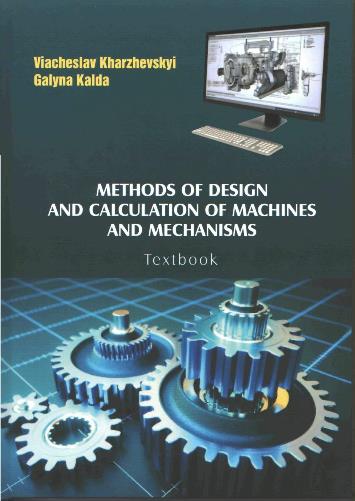 |
Автори підручника – викладачі факультету інженерії, транспорту та архітектури ХНУ: д.т.н., проф. кафедри галузевого машинобудування та агроінженерії В’ячеслав Харжевський, а також завідувач кафедри будівництва та цивільної безпеки д.т.н., проф. Галина Калда.
|
 Зміст Зміст
Preface 3
1. Kinematic study of mechanisms
1.1. Tasks and methods of kinematic study of mechanisms 4
1.2. Analogs of velocities and accelerations 5
1.3. Analytical study of the kinematics of planar linkage mechanisms by the method of closed vector loops 7
1.4. Group method of analytical study of kinematics of mechanisms 24
1.5. Examples of analytical study of the kinematics of planar linkage in Mathcad using the group method 42
1.6. Analytical study of the kinematics of 111 class mechanisms 49
2. Force analysis in linkage mechanisms
2.1. The main tasks of the dynamic study of mechanisms 55
2.2. Forces, acting in machines 55
2.3. Definition of inertia forces 56
2.4. Force calculation of planar mechanisms without taking into account friction forces 63
2.5. Force calculation of the II class planar mechanisms using unified subroutines 69
3. Dynamics of mechanisms and machines
3.1. Reduction offerees and moments offerees 100
3.2. Reduction of masses and moments of inertia 104
3.3. Equation of motion of mechanism 109
3.4. Study of the motion of mechanisms by Wittenbauer’s method 110
3.5. Unevenness and regulation of movement of mechanisms and machines 115
3.6. Average velocity and coefficient of unevenness of the machine 115
3.7. Determination of the coefficient of unevenness of the machine using Wittenbauer’s curve 120
3.8. Determination of the flywheel moment of inertia by Wittenbauer’s method 121
4. Cam mechanisms
4.1. General information 133
4.2. Basic parameters of cam mechanisms 133
4.3. Qualitative characteristics of the laws of motion of the output link 135
4.4. Synthesis of cam mechanisms 137
4.4.1. Synthesis methods and initial data 137
4.4.2. Synthesis of a cam mechanism with a roller pusher 137
4.4.3. Synthesis of a cam mechanism with oscillating follower 141
4.4.4. Synthesis of a cam mechanism with a flat-face follower 147
5. Gear transmissions
5.1. General Information 151
5.2. Geometric parameters of cylindrical involute gears 151
5.3. The main theorem of gearing 155
5.4. Sliding tooth profiles 157
5.5. Properties and equations of the involute of a circle 158
5.6. Theoretical output and forming contours 160
5.7. Calculation of geometric parameters of cylindrical spur gear using the condition of machine tool engagement 162
5.8. Calculation of geometric parameters of cylindrical spur gears using the condition of tight engagement of two gear wheels 165
5.9. Geometry of helical gears 168
5.10. Geometric and kinematic conditions of existence of transmission 171
5.10.1. Overlap ratio 171
5.10.2. Undercutting of the teeth 175
5.10.3. Sharpening of the teeth 177
5.10.4. Interference of teeth 177
6. Synthesis of linkage mechanisms
6.1. Main tasks of synthesis and methods of their solution 184
6.2. The condition for the existence of a crank in four-bar mechanisms 186
6.3. Synthesis of four-bar linkage mechanisms by two extreme positions of the output link 188
6.4. Synthesis of four-bar linkage mechanisms by the coefficient of change of the average velocity of the output link 194
6.5. Examples of the synthesis of 6-bar linkage mechanisms by the coefficient of change of the average velocity and the maximum stroke of the output link 202
7. Balancing of the mechanisms
7.1. The problem of balancing of mechanisms 209
7.2. Determination of the position of the center of mass of a planar mechanism 209
7.3. Method of replacement masses 214
7.4. Balancing of the mechanisms relative to the foundation 215
7.4.1. Conditions for balancing of the mechanisms 215
7.4.2. Complete balancing of the inertial forces of the mechanism 216
7.5. Balancing of rotating masses 220
8. Mathcad in engineering calculations
8.1. General characteristics of the Mathcad software package 225
8.2. Structure of the Mathcad package 228
8.3. Interface of the Mathcad package 229
8.4. Setting up the workspace 230
8.5. Working with text 232
8.6. Calculating the values of arithmetic expressions 232
8.7. Built-in functions and user-defined functions 234
8.8. Representation of range variables in Mathcad 234
8.9. Plotting graphs 235
8.10. Plotting graphics of surfaces and spatial curves 240
8.11. Vectors and matrices V. 240
8.12. Linear equations and systems of equations 241
8.13. Finding derivatives and integrals 244
8.14. Finding extrema of a function and series 245
8.15. Programming in Mathcad 246
References 249
Appendix A 250
|
Видання підручника стало можливим завдяки багаторічній міжнародній співпраці між нашим університетом та університетом «Жешувська політехніка» (Польща).
Навчально-методичні матеріали, що були включені в підручник, викладаються проф. Харжевським В.О. для аспірантів освітньої програми «Прикладна механіка» (гарантом якої він є) в межах нормативної дисципліни «Методи проєктування та розрахунку машин та конструкцій». Відповідна освітньо-наукова програма підготовки докторів філософії передбачає викладання українською мовою, проте, як доповнення, для аспірантів є також дуже корисним ознайомлення з відповідним навчальним матеріалом саме англійською мовою, оскільки це дозволяє ознайомитись з профільною технічною термінологією, що використовується в англомовних наукових публікаціях, що спрощує для них проведення літературного огляду за тематикою дисертаційних досліджень.
Матеріал підручника є також корисним для студентів університету «Жешувська політехніка» (Польща) з метою використання його для практичних занять з дисципліни «Podstawy konstrukcji urządzeń mechanicznych» («Основи конструювання механічного обладнання»), а також в рамках міжнародної діяльності за програмою Erasmus+, завдяки якій реалізується міжнародна співпраця між університетами.
У передмові, написаної проф. Харжевським В.О., зазначено: «підручник присвячено пам’яті професора Ярослава Кіницького як визнання його значного вкладу в розвиток розрахункових методів та методів проєктування у машинознавстві, Вчителю та Науковому керівнику, чиї ідеї та досвід допомогли створити цей підручник».
Зазначимо, що д.т.н., професор Кіницький Ярослав Тимофійович, відомий вчений в галузі машинознавства, працював в Хмельницькому національному університеті протягом 1963-2020 рр., причому з 1982 року був незмінним завідувачем кафедри машинознавства, яка зараз має назву галузевого машинобудування та агроінженерії.
Примірник підручника був подарований авторами до наукової бібліотеки Хмельницького національного університету.